





Tesla Coil & Capacitor Equations
Synopsis
A Tesla-coil builder's reference sheet: dielectric constants and puncture voltages for capacitor materials, plus the equations for sizing the primary capacitor, coils and frequency.
The sheet below is a classic Tesla-coil builder's reference: a table of dielectric constants and puncture voltages for the materials used in home-made capacitors, followed by the working equations a coiler actually needs — matching the primary capacitor to a neon sign transformer, finding capacitor reactance and primary inductance, combining capacitors in series and parallel, and the formulas for plate capacitors, Leyden jars, circuit frequency, pancake and helical primaries, wire length, spheres and toroids. It closes with a schematic, the author's bibliography and his safety warnings.
The ASCII table, fractions and radicals are reproduced exactly as they were written; nothing has been converted to modern notation.
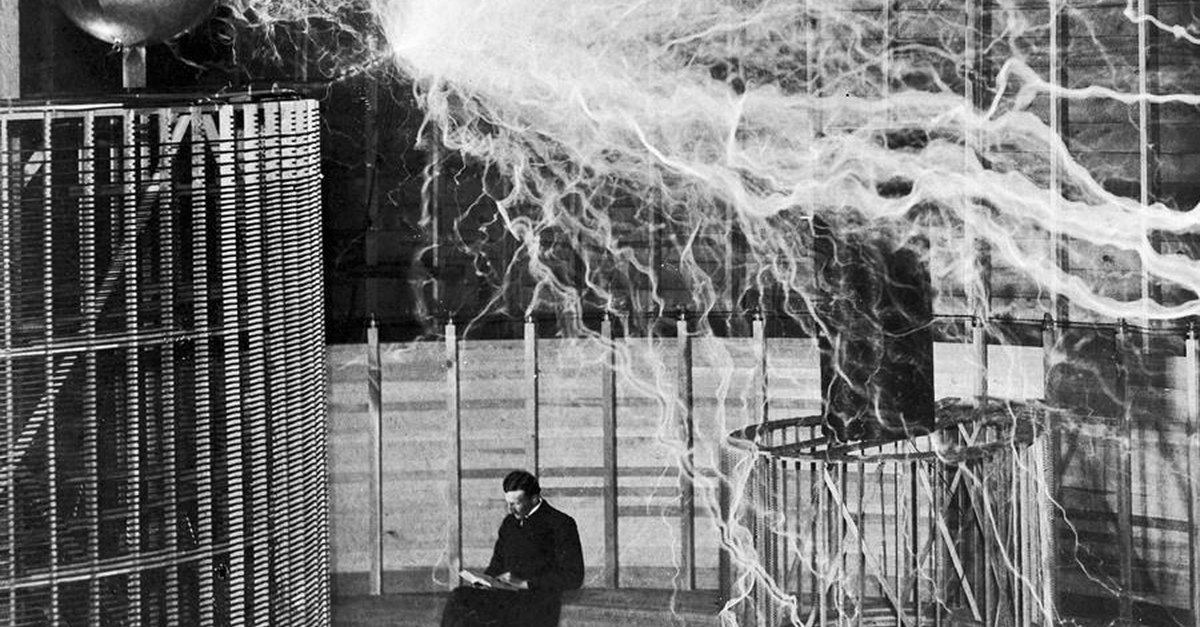
Information for building capacitors
INFORMATION FOR BUILDING CAPACITORS:                           Comments
                                                                 |
                                               Puncture Voltage  |
Material                   Dielectric strength   per Mil         |
                                  "K"           (0.001 inch)     |
                                   |              |              |
-----------------------------------------------------------------------
Miscellaneous
-------------
Vacuum                             1.0

Paper, bond                        3.0            200
Paper, Royal Grey                  3.0            200
Paper, telephone, treated          2.5 - 4        200 - 250      *
Paper, Parafin Coated              2 -3.5
Paper, Kraft                       2.2

Oil, Castor                        4.67
Oil, Mineral, Squibb               2.7            200
Oil, Mineral                       2.2
Oil, Transformer                   2.1 - 2.5      75             *

Rubber                             3.0
Rubber, Hard                       3.0            160 - 500      *
Rubber, Vulcanized                 3.2 - 3.9                     1

Fibre                              5.0 - 7.5      150 - 180
Fibre, Red                         5.0

Mica                               4.5 - 8.0      3800 - 5600
Mica, Ruby                         5.4            3800 - 5600

Quartz                             3.8 - 5.0      1000
Quartz (Fused)                     4.2            150 - 200      *

Shellac                            2.5 - 4.0      200 - 400
Spar Varnish                       4.8 - 5.5

Steatite, low loss                 5.8            150 - 315
Steatites (Magnesium silicate,etc) 5.5 - 7.5      200 - 300

Cambric (Varnished)                4.0                           2
Alsimag 196                        5.7
Gutta Percha                       4.0                           3
Amber                              3.0 - 7.0                     4
Resin                              2.48 - 2.57
Enamel                             5.1            450
Mycalex                            7.4            250
Silicone RTV                       3.6            550
Wood                               2.0 - 5.2
Wax (Parafin)                      2.1 - 2.5      250 - 450      *
Beeswax                            2.9 - 3.0
Slate                              7.0                           5
Barium titanate(25 C)              1200
Bariam titanate                    6000
Titanium dioxide                   125
Cellulose acetate                  3.3 - 3.9      250 - 600
Casein, Moulded                    6.4                           6
Polytetraflourethylene             2.0                           A
Aluminum oxide                     8.7
Tantalum pentoxide                 22

Glass
-----
Glass                              4.8 - 10       300
Plate Glass                        6.8 - 8.4
Pyrex Glass                        4.8 - 10       335
Window Glass                       7.6 - 7.8      200 - 250

Ceramics
--------
Cordierite ceramics                5.0 - 5.5      100
Magnesium titanate ceramic         12 - 18        150
Porcelain                          5.1 - 7.5      40 - 280
Titanium dioxide ceramic           70 - 90        100
Titanium-zirconium dioxide ceramic 40 - 60        150

Plastics
--------
Bakelite                           4.4 - 5.8      300
Bakelite, Mica filled              4.7            325 - 375
Epoxy Circuit Board                5.2            700
Formica                            4.6 - 4.9      450            7
Nylon (lowest values of 3 types)   3.2            407
PVC (rigid type)                   2.95           725
Plexiglass                         2.8            450 - 990
Polyethylene                       2.2 - 2.3      450 - 1200
Polycarbonate (Lexan)              2.96           400
Polyethylene Terphthalate (Mylar)  3.0 - 3.1      7500
Polystyrene                        2.5 - 2.6      500 - 700
Teflon                             2.1            1000 - 2000

Gases
--------
Air (dry air at 1 atm)             1.0006         30 - 70
Air (20 atm, 19 deg. C)            1.0108         500            *
Carbon dioxide ( 1 atm, 0 deg. C)  1.000985       36             *
Carbon dioxide (20 atm, 15 deg. C) 1.020
Hydrogen (1 atm,0 deg.C)           1.000264       26.1           *

Liquids
--------
Amonia (liquid)                    22
Benzene                            2.28
Carbon tetrachloride               2.24                          8
Chlorinated diphenyl               6.5                           9
Ethyl Alcohol (O C)                28.4
Ethyl alchohol (20 deg.C)          25.8
Methyl alchohol                    33.1
Water (distilled)                  80 - 81
Legend
*= Measured in kilovolts per centimeter. All others are volts per mil (.001 inch) unless otherwise stated.1= Vulcanized means it has been melted, or heated in some way.2= Cambric is a finely woven white linen or cotton fabric.3= Gutta Percha is a rubbery substance made from the latex of tropical trees and is used in insulation, waterproofing, and dentists use it in thin sheets sometimes when working on teeth.4= Amber is a hard, translucent, yellow, orange, or brownish yellow fossil resin, used in making ornamental objects like jewelry.5= Slate is a fine grained metamorphic rock that splits into thin smooth faced layers. Black boards for writing are made of this. Also used as roofing material in some areas.6= Casein is a white, tasteless, odorless milk and cheese protein used in the manufacture of plastics, glues, paints, and food. The word 'moulded' means it has been shaped by a mold.7= Formica is a trademark for any of various high-pressure laminated plastic sheets of melamine and phenolic materials used for chemical and heat-resistant surfaces.8= Carbon tetrachloride is a very toxic substance. It has also been shown to cause cancer in lab animals. It is banned in most labs. It is a liquid that was used as a strong solvent.9= Chlorinated diphenyl is a liquid dielectric that is used to impregnate Kraft paper in small A.C. capacitors. This is a PCB and may cause cancer, handle carefully.A= Polytetrafluoroethylene films retain good properties even at 200 degrees Celsius (200 C).atm= atmospheres (pressure of air at sea level is 1 atm).deg.C= degrees Celsius.
Warning — Some liquids and gases listed may be explosive under the right conditions. Many solids can catch fire and burn. Use CAUTION and GOOD COMMON SENSE.
Note: Some books gave very different values for each substance so I have given you the highest and lowest values reported. The values will depend on the purity of the substance you're using. If you know your substance is very pure then use the higher value reported. If you know your substance is contaminated or of poor quality then use the lower values reported. If you have unknown purity then use the average of the values given.
Explanation of equations
Here are some real handy equations. They are very simple and easy to use.
x= multiply by./= divide by (may also use a line separating terms above and below the line, as in standard mathematics).( )= terms in parentheses should be calculated first, as in standard algebraic equations.pi= 3.141592654. The circumference of a circle divided by its diameter will always give you this constant.Z²(drawn in the sheet as a small2above the term) = the term "Z" multiplied by itself one time, "Z x Z".
Note: In some cases I do not use the symbol "x" but instead simply put the terms close together, example: "LC" instead of "L x C". This is standard for algebraic equations and means "multiply by".
Math for Tesla coils
1. Determine your neon sign transformer's (or other transformer's) impedance
       E
Z  =  ---
       I
Z= impedanceE= voltsI= current in amps
Note: divide milliamps by 1000 to get amps. 30 milliamps = .030 amps.
The impedance of the primary capacitor should match the impedance of the transformer at 60 Hz (60 Hz is the AC cycle rate of common household wall sockets, at least in America).
2. To match impedance and determine capacitor value
              1
C =   -------------------
      2 x pi x Z x .00006
C= capacitance in microfarads needed for primary capacitor.Z= impedance from equation one (transformer impedance).pi= 3.141592654
Note: The .00006 is the 60 Hz AC; if you live outside the US then substitute your cycle rate.
Next you need to find the reactance of the primary capacitor at the frequency you have chosen. Many times the frequency is decided by the length of wire used on the secondary coil. See below for equations that determine frequency by length of wire used on secondary. When we find the reactance, we can then find your needed inductance for the primary coil.
3. To determine reactance of capacitor
            1
X(C) = ---------------
       2 x pi x C x F
X(C)= capacitor reactanceC= capacitor value in microfarads, from equation 2F= frequency in MHz (megahertz)pi= 3.141592654
Note: To convert kilohertz to megahertz simply divide by 1000. 190 kHz = .190 MHz.
4. To determine the inductance needed for primary coil
Set X(L) = X(C)

             X(L)
      L = ------------
          2 x pi x F
L= inductance in microhenries needed for primary coil. To get millihenries divide the answer by 1000.X(L)= reactance from equation 3, same as X(C).F= frequency in megahertz. Divide kHz by 1000 to get MHz.pi= 3.141592654
Now you know the values for your capacitor and primary coil. These values will give you the best ringing for your circuit (i.e. more bang for your buck)! Use the equations below to finish the project.
Note: Many people don't go to the trouble to work these equations out. They simply slap the parts together and then try to tune. If you work the equations out first you will save lots of time in tuning, you will at least be in the right ball park! Also, just because you worked it out on paper that doesn't mean it will work the first time you plug it in. Trial and error is a large part of the Tesla coil hobby!
Capacitors in parallel and in series
Capacitors in parallel
|      |
|__C1__|
|      |
|__C2__|
|      |
|__C3__|
|      |
Capacitance = C1 + C2 + C3, etc...
Maximum voltage rating will be equal to the voltage rating of the lowest voltage capacitor of the group.
Capacitors in series
                                         |              |
                                         |__C1__C2__C3__|
                                         |              |
                                         |              |

                   1     1     1
Capacitance = 1 / --- + --- + ---, etc...
                  C1    C2    C3
- The total capacitance of several capacitors in series will always be LESS than that of the smallest capacitor.
- Total voltage rating increases with number of capacitors in series. Simply add the voltage ratings together.
- When capacitors are placed in series to increase voltage rating they should have the same capacitance and voltage rating, else voltages will divide unevenly, most likely causing failure.
Equations 1–10
Equation 1: Plate type capacitors
Capacitance (in picofarads) = (0.224 KA / d) (N-1)


    0.224 x Dielectric Strength x Area of plate
C = -----------------------------------------  x (Number of plates - 1)
      distance between plates in inches
Note: to convert picofarads to microfarads divide by 1,000,000.
Equation 2: Leyden jar or salt water type capacitors (jar/bottle type)
                    2
C = .0884 k ( pi  r   + 2  pi  r  l )
     ------------------------------
             1,000,000 t
C= capacitance in microfaradsk= dielectric strengthr= jar radius in centimetersl= height of the jar portion used (in centimeters)t= thickness of the jar wall in centimeterspi= 3.141592654r²= r x r (radius squared)
Equation 3: Frequency of a circuit
             1
f =  --------------------
             __________
     2 pi   / L C

              _________
The symbol " /          " means the square root
f= frequency in cycles per secondL= circuit inductance in henriesC= circuit capacitance in faradspi= 3.141592654
For a result "f" in kHz: enter "C" in microfarads, "L" in microhenries and multiply the result by 1000.
Equation 4: Inductance of a flat pancake coil
Picture a 1 inch flat ribbon that is about 30 feet long. Now, roll that ribbon into a spiral that has all its sides about 1/2 inch apart. Most common material is aluminum roof flashing. Use plastic bolts to hold sections of strips together if you have short pieces of ribbon. This makes a good mechanical connection (you can't solder aluminum).
                              center axis
                              |
                 | | | | |    |    | | | | |       section
                              |                        of flat spiral
                     |---A----|    |---W---|           coil.
                              |

       2         2
     a     x   n
L = ---------------
     8 a   +   11w
L= inductance in microhenries.a= average radius in inches as measured from the central axis to the middle of the winding.n= number of turns in the winding.w= width of the coil in inches.
Note: Make sure you measure "a" from the center axis — the very middle of your secondary sitting inside of your primary.
Equation 5: Number of turns for a helical primary
             _________________________
            /
  N =     /  L  [( 9 x R) + (10 x H)]
         /  --------------------------
       /            2
    \/            R

              _________
The symbol " /          " means the square root, in this case of whole
equation.
N= number of turns needed.L= inductance in microhenries desired.R= radius (inches).H= height (inches).
Equation 6: Length of wire needed for desired frequency of coil
        300,000
L =     -------  / 4 x (3 / .9144)
           f
f= frequency, in kHz, that is desired for coil.L= length of wire needed, in feet, for desired frequency./= divided by.
Note: 300,000 is the speed of light in kilometers per second. The term "3/.9144" is a conversion factor to turn meters to feet. You don't have to understand this. Just thought I would tell those who were wondering.
Equation 7: Frequency of coil
              300,000
f =  ------------------------------
     T x W x pi x (.9144 / 36) x 4
f= frequency of coil in kHzT= number of turns on coilW= width of the coil in inchespi= 3.141592654
Equation 8: Capacitance of a sphere in space
          R
C =   -------
            9
      9 x 10

    9
9x10  = 9,000,000,000
C= capacitance in faradsR= radius in meters
Note: To convert farads to microfarads simply multiply by 10^6, or in other words by 1,000,000.
Equation 9: Capacitance of a sphere suspended in a dielectric
      K x R
C = ---------
           9
    9 x 10
C= capacitance in faradsR= radius in metersK= dielectric constant
Note: To convert farads to microfarads simply multiply by 10^6, or in other words by 1,000,000.
Equation 10: Capacitance of a toroid
                                           ___________________
                                          /    2
C =(1+ (0.2781 - d2/d1)) x  2.8  x      /  2 pi  (d1-d2)(d2/2)
                                      /   -------------------
                                   \/      4 pi
C= capacitance in picofarads (+- 5%)d1= outside diameter of toroid in inchesd2= diameter of cross section (cord) of toroid in inches
Equation courtesy of Bert Pool.
Tesla coil schematic
 TESLA COIL SCHEMATIC                                  --------
                                                       |      | TC
                                                       --------
                                                           O
                                                           O
            SG   SC      FCC     PC   SG        P-COIL     O S-COIL
        O---------------OOOOO---------> O        O
     O||O                                         O        O
-----O||O    *   ---            ---               O        O
110   | O    |    |              |                O        O
Volts | O    |    |              |                O        O
      | O---------------OOOOO---------------------|        |
      |                                                    |
      |                                                    |
     Gnd                                                  Gnd
NST= Neon Sign Transformer, 110 volts primary, 15,000 volt secondary at 30-60 milliamps.SG= Safety Gap. A spark gap to insure your transformer doesn't get fried.SC= Safety Capacitor. 300-500 picofarad rated at 50 KV.FCC= Ferrite Core Choke. This prevents real high voltages from coming back towards your transformer. It also separates the capacitors.PC= Primary Capacitor. Normally .01-.02 microfarads rated 50 KV.SG= Spark Gap.P-COIL= Primary Coil.S-COIL= Secondary Coil.TC= Terminal Capacitor. The big ball or coffee can on top.Gnd= Ground.
Note: This is one of several possible schematics. It's just the one I happen to use.
Warning and safety tips
Only people who are experienced with high voltage devices should attempt to build Tesla coils. They can be very deadly if you don't know what you're doing. Remember, if they find you on the floor turning blue and frothing at the mouth — THERE IS NO SECOND CHANCE!
A few safety tips:
- Don't ever touch the machine when it is plugged in.
- Use a safe method to short out the primary capacitor after the machine has been run.
- Don't ever get close to a running Tesla coil, the primary can shoot hot white arcs at you that will kill you instantly!
- Always have a small fire extinguisher close by.
- Always use kickback preventer circuits so you don't send 15,000 volts back through the wall!
- Pets, children, and irresponsible adults should be kept away from your machine entirely!!!
- Read many books on Tesla coils and other high voltage devices and learn as much as you can about high voltage safety!
Author's closing note
Special thanks to Mr. Pool who caught some glaring errors in the second draft and who contributed with an equation of his own.
I wrote this file because I felt there was a need for some real information for those of us who actually build Tesla coils, as opposed to those who just talk of building them (grin). I will be adding to this file from time to time, so watch for updates. I hope it helps you out!
P.S. Let us not forget the words of Tesla, "Let the future tell the truth and evaluate each one according to his work and accomplishments. The present is theirs, the future, for which I really worked, is mine".
References
Bibliography given in the original sheet:
Books
- Theory and Applications of Electricity and Magnetism, Charles A. Culver, 1947, McGraw Hill Book Company, Inc.
- Concept In Physics, Third edition, Franklin Miller Jr., Thomas J. Dillon, Malcom K. Smith, 1980, Harcourt Brace Jovanovich, Inc.
- Tesla Coil Secrets, R.A. Ford, 1985, Lindsay Publications Inc.
- Tesla Coil, George Trinkaus, 1989, High Voltage Press @ Lindsay Publications.
- High Frequency Apparatus, Thomas Stanley Curtis, 1916, Lindsay Publications.
- Allied Electronics Data Handbook, 1970
- Tesla Coil Design Manual, J.H. Couture, 1992
- Radio Amateur's Handbook, 1972
- Elements of Physics, 1964
Articles
- Popular Electronics, "Make Your Own High Voltage Capacitors", Anthony Charlton.
Related: Tesla Patents · Nikola Tesla · Nikola Tesla Secret
Sources
Related videos
 ▶ video
 ▶ video
 ▶ video
 ▶ video
 ▶ video
 ▶ video
 ▶ video
 ▶ video
 ▶ video
 ▶ video
 ▶ video
 ▶ video
Related documents
 PDF
PDF PDF
PDF PDF
PDF PDF
PDF PDF
PDF PDF
PDF PDF
PDF PDF
PDF PDF
PDF PDF
PDF PDF
PDF PDF
PDF