Cannabinoid Synthesis and Decarboxylation Process
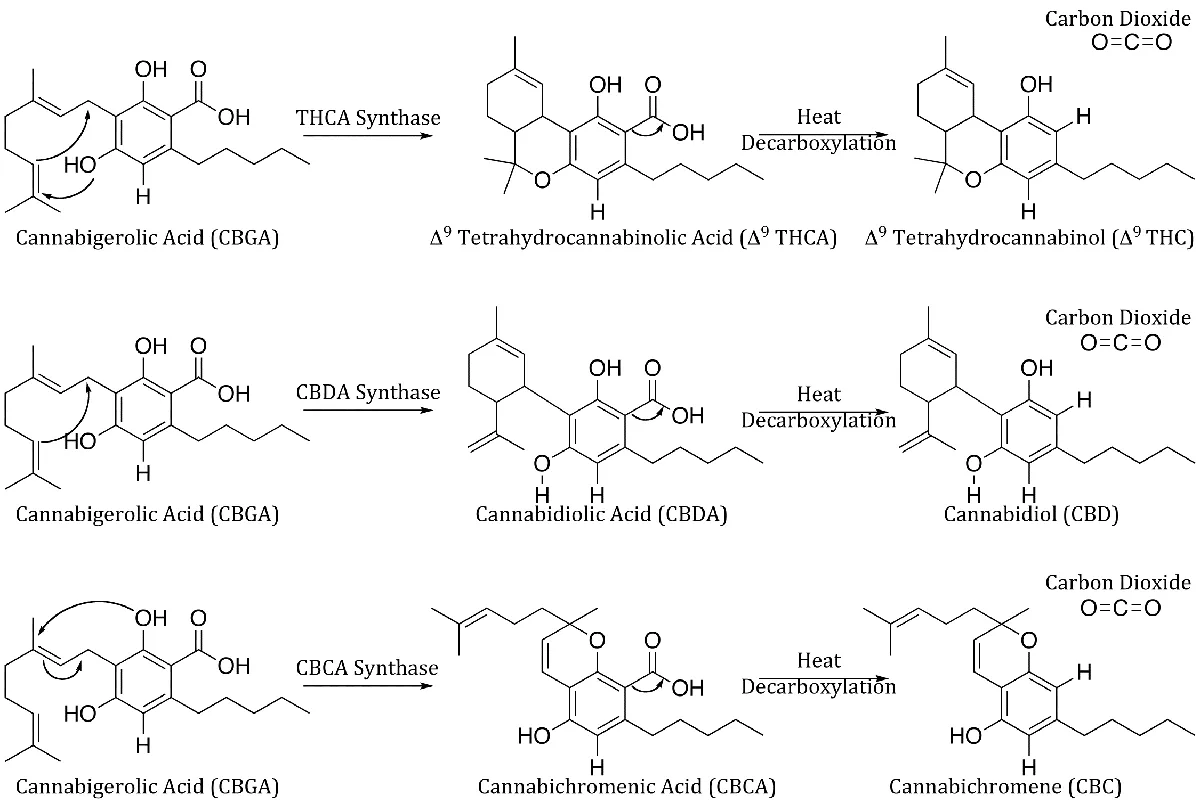
Chemical synthesis pathways of cannabinoids: Cannabigerolic Acid (CBGA) is converted into Δ⁹-Tetrahydrocannabinolic Acid (Δ⁹-THCA), Cannabidiolic Acid (CBDA), and Cannabichromenic Acid (CBCA) via specific synthases, followed by heat-induced decarboxylation to form Δ⁹-Tetrahydrocannabinol (Δ⁹-THC), Cannabidiol (CBD), and Cannabichromene (CBC), respectively, with the release of carbon dioxide.
This diagram illustrates the biosynthesis of cannabinoids starting from Cannabigerolic Acid (CBGA). CBGA is transformed into Δ⁹-Tetrahydrocannabinolic Acid (Δ⁹-THCA), Cannabidiolic Acid (CBDA), and Cannabichromenic Acid (CBCA) through the action of specific synthase enzymes (THCA synthase, CBDA synthase, and CBCA synthase). Upon heating, these acidic cannabinoids undergo decarboxylation, losing a carbon dioxide molecule to form Δ⁹-Tetrahydrocannabinol (Δ⁹-THC), Cannabidiol (CBD), and Cannabichromene (CBC), respectively.